Real web performance, for real
In every detail.
Your website must be fast
for the people who use it, not just for the Google PageSpeed test
We work by hand on both server and application. We combine CrUX data and lab tests to improve loading, responsiveness and stability. No PageSpeed shortcuts.
CROSS-PLATFORM EXPERTISE.
YOUR CMS IS THE STARTING POINT.
 WordPress
 WooCommerce
 PrestaShop
 Magento
 Joomla
 Drupal
 Custom

A green score
can hide
a site that is still slow
or even be fake.
“In more than twenty years of enterprise hosting we have seen developers and DevOps engineers rig Google PageSpeed Insights with plugins that blocked JavaScript only when they recognized the testing tool. The client saw the green badge and was satisfied, while real users abandoned a slow, frustrating site.”

Managed Server S.r.l.
Manual work,
crafted and tailored.
Some sites have never been optimized, and in others the optimization stops at appearances: the test shows excellent results, but visitors keep waiting, clicks lag and content moves around.
When PageSpeed is detected and JavaScript or features are excluded only during the test, the measurement is being rigged. Even moving all the work to the first click can improve the initial score without solving the user’s problem. It is the gap between performance on paper and performance people actually experience.
We analyze the causes, work on server and code, and apply good development and web performance practices. We combine CrUX and LABS data, check that features still work and verify what happens after the page has loaded, on different devices and connections.
We optimize the site your customers use, in every interaction.
From symptom
to result.
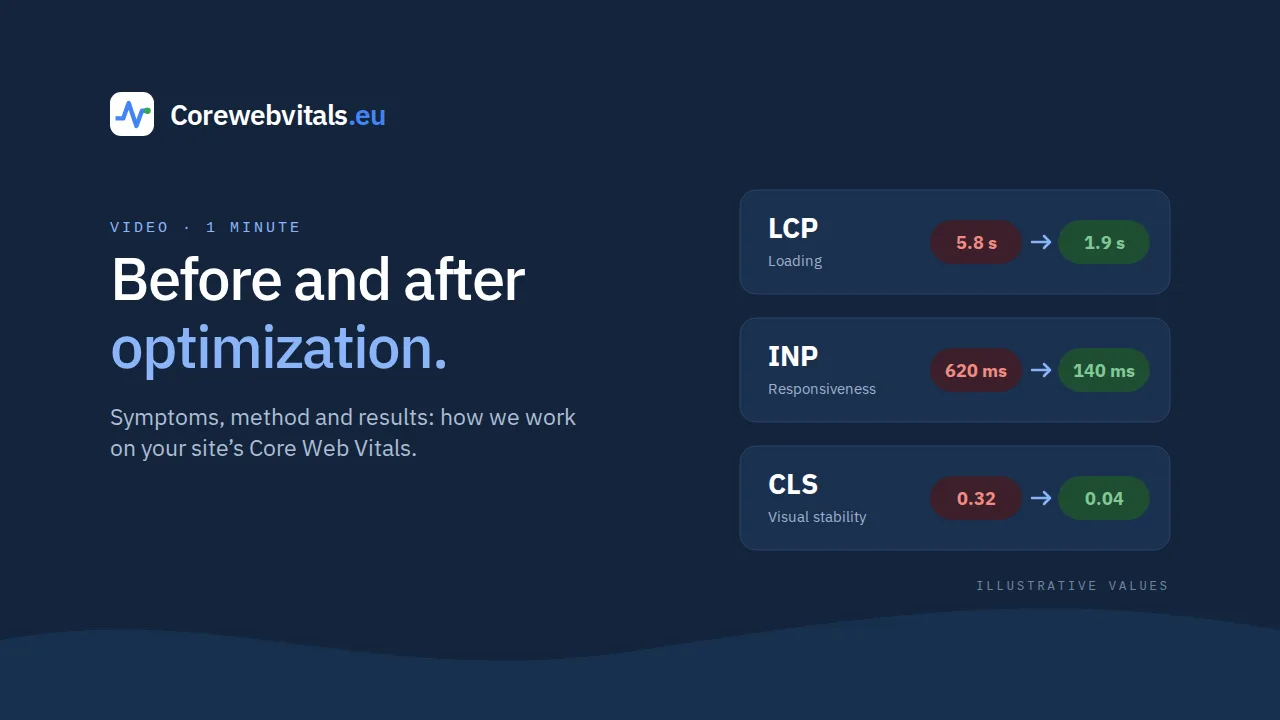
Pages that stay blank, clicks that respond late, content that moves around: in one minute we show you how we find the causes and how we verify the improvement, before and after the work.
What our
clients say.
A selection of public reviews of Managed Server services: hosting, support and performance.
Scroll through the testimonials or use the arrows.
“The level is high in terms of both skills and support.”
The reviewer says they turned to Managed Server’s services almost on a whim and found a high level of both systems expertise and support.
Read the review on Trustpilot“We have been working with Managed Server for years with excellent results!”
The reviewer runs two workwear e-commerce stores and highlights the team’s technical know-how and the quality of the tools provided.
Read the review on Trustpilot“Clear, competent and professional”
A short, direct review of the consulting received, praised for its clarity, competence and professionalism.
Read the review on Trustpilot“A happy client since 2016”
The review describes a long-standing relationship, with the main projects and the most important clients entrusted to Managed Server.
Read the review on Trustpilot“Fast and professional.”
It describes how a complex move to a new server was handled, with optimization work carried out during the migration.
Read the review on Trustpilot“we have never had a security problem or attacks like before”
After moving their sites, the reviewer describes a compromised site being recovered quickly without long downtime, and better speed and security.
Read the review on Trustpilot“Marco has always been ready to step in”
The review describes a stable service, with very rare problems solved in next to no time whenever they came up.
Read the review on Trustpilot“an extremely competent technical staff”
The review highlights the promptness of the support and the team’s availability for businesses’ day-to-day needs.
Read the review on Trustpilot“Great service and excellent support”
After several months of use, the reviewer stresses the quality of the performance and the availability of the support received from Managed Server.
Read the review on Trustpilot“The best Italian hosting in every sense.”
After years of switching providers, the reviewer reports support at any hour of the day or night, servers always up and very fast interventions.
Read the review on TrustpilotExcerpts and summaries of reviews of the company’s services, translated from Italian; not results specific to this Core Web Vitals service.
All reviews ↗The score is
a signal.
The user is the benchmark.
We measure what matters to the people browsing: waiting times, smoothness and response to input, even in the least favorable conditions.

The same page.
For the test and for people.
An excellent report is only worth something when it describes a site that works better. That is why we fix the causes of slowdowns and also check what happens after the page has loaded.
Fixing the causes
Server, queries, code and assets: every change comes from analyzing your project.
Consistent behavior
No special version for the tester. Optimizations must serve your visitors too.
Features preserved
We check navigation, interactions and checkout flows, not just loading times.
Caches, plugins and CDNs are tools. Their value depends on how they are configured and on their effect on the real experience.
Server and application.
Speed comes from the whole.
A fast server is the starting point. An efficient application completes the job. To truly optimize Core Web Vitals you need to understand and control both.
Infrastructure is only one part.
A hosting provider usually focuses on server configuration, caching, compression and response times, including TTFB. This work is essential, but reviewing PHP, HTML, CSS and JavaScript is often outside the service.
If the problem comes from the theme, a plugin or the code running in the browser, server optimization alone is not enough: the application needs work too.
Code is the other part.
A developer works on PHP, HTML, CSS and JavaScript and can improve rendering, assets and interactions. Systems administration, however, often lies outside their remit or beyond their access to the infrastructure.
If the bottleneck is in the PHP configuration, the database or cache management, working only on the front end leaves part of the problem unsolved.
A complete view.
Coordinated work.
We combine systems administration and application development to follow every request from server to browser. We understand how infrastructure, database, PHP and page code affect one another, so we can fix the causes of slowdowns in the right place.
We know the specifics of WordPress, WooCommerce, PrestaShop, Magento, Joomla, Drupal and custom systems. We verify the effects of our work with CrUX and lab data, keeping the real experience of the site’s users at the center.
From server to browser.
One single job.
Every wait has a cause. We look for it along the entire path of the request, connecting systems expertise and application development.
A more efficient
response.
We reduce the work needed to generate and deliver the page.
- Web server and PHP
- Queries, indexes and database
- HTTP cache and object cache
- Compression and protocols
Only the code
you really need.
We work on what the site loads and runs on every journey.
- Themes, plugins and modules
- JavaScript and third parties
- Images, fonts and CSS
- Cart and dynamic pages
A smoother
experience.
We check how the page appears and responds on real devices.
- Rendering and priorities
- Main thread work
- Layout stability
- Interactions and navigation
Consistent performance, even when the network slows down and the device is less powerful.
Beyond the myth of plugins
and one-click solutions.
WP Rocket, FlyingPress, WP-Optimize, Perfmatters, NitroPack and similar tools offer useful automation, with different features and controls. But switching on generic options without diagnosing and checking the project is not the same as optimizing it properly.
Real optimization is precision work: surgical changes, dependencies included, and verified results.
Postponing work does not remove it.
Delaying scripts across the board can lighten the initial load, but it piles downloads and execution onto the first tap. Without targeted exclusions and dependency checks, menus, search or the cart may start working late. We assess which scripts are needed immediately, which can wait and which can actually be removed.
Every shortcut has a cost to measure.
Automatic removal of unused CSS must also be checked on open menus, filters, product variants and other dynamic states. Inlining CSS or JavaScript can reduce requests, but it makes the HTML document larger and stops those assets from being reused as separate files in the browser cache. These are techniques to apply with care, not settings to switch on everywhere.
Causes first, tools second.
We work on templates, conditional loading of assets, dependencies and unnecessary code. If a plugin is useful, we configure it selectively and verify its effects: an enabled feature is not, by itself, a guarantee of improvement.
A large archive
is not a brochure website.
Systems that generate CSS or optimized versions per URL have to handle processing, storage and regeneration after invalidations. On large catalogs and editorial archives, separate mobile and desktop variants can multiply the work too.
The risk to assess is turning optimization into an additional operational burden: long queues, requests to the origin, resource consumption and cache rebuild times. The impact depends on the system, the settings and how often content is updated. So we design reusable changes at template level and targeted invalidations, checking that they stay sustainable at scale.
Technical references: per-URL CSS generation · JavaScript delay controls · regeneration of optimized pages.
CrUX and LABS.
The complete picture.
Field data shows what happens. The lab helps you understand why. We use them together, before and after every change.
- 01CrUX
Observe
We read the users’ experience, separating mobile, desktop and pages with available data.
- 02LABS
Diagnose
We reproduce the problems and analyze network, rendering and JavaScript with Lighthouse and DevTools.
- 03CHANGES
Optimize
We make targeted changes to configuration and code, checking that features keep working.
- 04CrUX
Confirm
We compare the tests and follow how the metrics collected in the field evolve.
In CrUX reports, with their rolling 28-day window, the effect of the changes shows up gradually. If there is not enough data, we add LABS tests and, where agreed, RUM measurements.
Smoother.
On every journey.
Performance carries people all the way to what matters: a purchase, an article read or a contact request.
From product
to order.
Product pages, search, cart and checkout: we remove technical obstacles along the purchase journey. We optimize images, filters and dynamic features to make every interaction faster, on mobile too. The goal is to take customers from choosing a product to confirming the order with less waiting.
More room
for reading.
Readable content, stable layouts and advertising scripts under control, even on less powerful smartphones. We work on images, fonts and third-party resources to put reading first. We balance speed and monetization, limiting slowdowns and elements jumping around while articles are being read.
Every visit
deserves attention.
More efficient landing pages, initial content and forms, so visitors reach the contact step without needless waiting. We optimize how the main messages load and how the page responds to interactions, keeping the weight of tracking and integrations under control. Every visit can then move on to an enquiry more smoothly.
The impact on conversions and commercial results has to be assessed on your own data, together with your offer, content and traffic quality.
Performance and results.
The public data.
LCP ≤ 2.5 s
Google recommends achieving good Core Web Vitals for success with Search: LCP within 2.5 s, INP under 200 ms, CLS under 0.1. Together with the other aspects of page experience, they align with what Google’s ranking systems seek to reward.
Source: Google Search Central+8% sales
A 31% improvement in LCP led to 8% more sales. In the same A/B test, the lead-to-visit rate (+15%) and the cart-to-visit rate (+11%) also grew.
Source: web.dev, 2021−43% bounce rate
LCP from 4.5 to 2.5 s and CLS from 0.25 to 0.09: bounce rate down by 43%. The publisher, which previously failed the thresholds, passed them across its whole origin.
Source: web.dev, 2021+7% sales
INP reduced from about 870–900 to 350–370 ms, with an overall 7% increase in sales. The result came from deferred loading of components and lighter input handling.
Source: web.dev, 2023Results from third-party companies published by Google on web.dev. The impact on your business depends on your site and has to be measured on your own data.
Clear priorities.
Concrete changes.
Readable results.
We define the work around your site’s needs, with a comparison between the starting point and the result.
Let’s plan your project
- 01
Initial analysis
Representative pages, available data and server and application bottlenecks.
- 02
Action plan
Priorities, feasibility and dependencies on hosting, platform and external services.
- 03
Implementation and checks
Agreed changes and checks on the journeys and features involved.
- 04
Before and after comparison
Tests in comparable conditions, a summary of the work and a reading of the field data.
- 05
Ongoing analysis
A new scheduled analysis every four months to catch regressions and new opportunities for improvement.
A few logins.
No surprises.
- 01
Access to hosting or a staging site
To work on server, cache and database, and to test changes before release.
- 02
Admin access to the CMS
Themes, plugins and modules, with dedicated users to be removed once the work is done.
- 03
Available data
Search Console, GA4 or other analytics tools, if you have them, to read the real experience and the pages that matter.
- 04
Priority pages and journeys
The pages and processes that matter most to your business: catalog, articles, checkout, forms.
- 05
A point of contact
A person or the agency who knows the project, for decisions and checks.
We protect your data and credentials: on request we sign a non-disclosure agreement, and we process data in line with the GDPR.
The reasons behind our method.
Since 2005 we have supported Italian businesses and publishers with hosting, systems administration and web performance services for the main CMSs. Performance optimization has always been part of our work. For years we chose not to offer it as a standalone service, out of respect for the developers and web agencies who entrust us with their clients’ infrastructure.
Today we put this experience at the service of anyone looking for real optimization that improves everyday browsing. Our method starts from the causes of slowdowns and works on server and application, without tricks that lighten pages only during tests. We combine CrUX data and lab measurements to set priorities and verify the benefits for users: faster loading, responsive interactions and stable content.
Clear pricing.
Tailored work.
Three starting points, one method: technical analysis and manual optimization. The quote is based on your CMS, your features and the complexity of the project.
News site or blog
WordPress, Joomla, Drupal
- PageSpeed Insights and Core Web Vitals optimization
- Analysis of CrUX and lab data
- Optimization for mobile browsing on 4G
- Images optimized for weight and size
- Optimized response to Google crawlers
- Changes to templates, CSS and JavaScript
- TTFB target below 100 msOn cached pages, under the agreed conditions.
E-commerce
WooCommerce, PrestaShop, Magento 2
- PageSpeed Insights and Core Web Vitals optimization
- Analysis of CrUX and lab data
- Optimization for mobile browsing on 4G
- Optimized product images and catalog assets
- Changes to categories, product pages and filters
- Checks on cart, checkout and integrations
- Optimization of cache, queries and response times
Custom
Vanilla PHP, Node.js, Laravel, Yii and custom systems
- PageSpeed Insights and Core Web Vitals optimization
- Analysis of CrUX and lab data
- Diagnosis of the architecture and bottlenecks
- Targeted work on rendering, CSS and JavaScript
- Optimization of images and critical assets
- Analysis of backend, queries and caching strategies
- Checks on the agreed journeys and features
Indicative starting prices, VAT excluded. Activities, scope and goals are agreed after the technical assessment. The TTFB target also depends on infrastructure, cache, distance and network conditions: it is verified under defined conditions and is not extended to every request or device.
Your client stays yours.
We work with you.
For years we chose not to offer optimization as a standalone service, out of respect for the developers’ role. Today we also offer it to agencies, as technical support for your work.
Alongside you or white label
We work with your team or behind the scenes, with no contact with the client unless you want it. We agree on approach, priorities and communication with you: the client relationship stays yours, from analysis to delivery.
Documented changes
Every change is described, so your team can maintain it over time. We share the list of changes, the technical reasons and what to re-check after theme, plugin or module updates.
Server and code together
We also work where the developer has no access: server configuration, cache and database. We connect the infrastructure work with the code work, so bottlenecks get solved in the right place, without passing the buck between hosting and development.
Does your site show
these symptoms?
Sometimes a few seconds of browsing are enough to notice that something is not working as it should. Do you recognize any of these situations?

On mobile, the wait is noticeable.
The page stays blank, images arrive late and reading takes patience, especially on a less stable connection.
You tap the menu. The response lags.
Buttons, search and filters look ready, but they don’t react straight away to the first tap. The user waits or tries tapping again.
Content moves while you browse.
You are reading or about to tap something when images, banners or other content shift position and make you lose your place.
Checkout tests your patience.
Adding a product, updating the cart or moving to payment involves waits that break the purchase journey.
The score is green. The browsing isn’t.
The report looks reassuring, but when you actually use the site you run into delays and freezes. That number doesn’t tell the whole story.
Let’s be clear.
Technical expertise and transparency, from the very first conversation. Realistic goals and concrete answers, no false promises.

Do you guarantee a score of 100 on PageSpeed?
No. We aim for the best sustainable result for your site, keeping its content and features. The lab score also depends on test conditions and third-party resources: chasing 100 at all costs can lead to compromises that do little for the people using the site.
We start from the bottlenecks, set the priorities and verify the effect of our changes on the most important pages and journeys. We assess loading, stability and responsiveness together with field data, to deliver concrete benefits even when the device is less powerful or the connection slows down.
Do you also work on e-commerce and custom sites?
Yes. We work on WordPress, WooCommerce, PrestaShop, Magento, Joomla, Drupal and custom applications. We adapt the work to the project’s architecture, taking into account themes, plugins, modules, integrations and how the pages are generated.
The analysis covers the journeys that matter for your business: browsing the catalog, search, filters, cart, checkout and form submissions. In custom systems we also examine the relationship between application code, database and infrastructure. This way we identify the most useful changes and verify their effect on the features involved, instead of stopping at the homepage result alone.
Do I have to change hosting or remove the CDN?
We decide that after the analysis. We start from your current infrastructure to understand what is holding the site back and what can be improved with a more effective configuration. Caches and CDNs can be part of the solution when they really speed up content delivery and suit the application’s needs.
We examine response times, available resources, cache behavior and dynamic pages. If we find limits that prevent the goals from being reached, we explain which changes we recommend and why. Any decision to change hosting is therefore based on technical evidence, with attention to service continuity.
When will I see the improvements?
The first effects can be verified in controlled tests as soon as the changes are applied. We compare the pages before and after, in comparable conditions, and also check that menus, forms and checkout flows keep working correctly.
The CrUX data in PageSpeed Insights, on the other hand, reflects a rolling 28-day window: earlier results are gradually replaced by new user experiences. This is why the improvement in the field does not necessarily appear all at once. Timing and priorities depend on the complexity of the project, the integrations in place and whether there is enough data to assess the trend.
What is the difference between CrUX and LABS data?
CrUX data describes the experience of real Chrome users, on different devices and connections. In PageSpeed Insights it covers the last 28 days and is available when there is a large enough sample. LABS data, by contrast, comes from a Lighthouse test in controlled conditions: it helps identify the causes of slowdowns and verify changes immediately.
We analyze them together: CrUX shows what happens in the field, while lab tests help you understand where to act. A good result in one does not make the other unnecessary. How Google distinguishes field and lab data ↗
I already have a web cache: do I still need optimization?
A web cache is an excellent starting point: it can reduce the server’s work and the time needed to return a page that has already been generated. The browser, however, still has to download the assets, run JavaScript and build the interface. Heavy images, third-party scripts and layout instability can slow down the experience even with a very fast server response.
In addition, the cart, checkout, private areas and personalized content may need processing that the page cache does not cover. So we check both the responses served from the cache and those generated by the application, and we also work on what is left for the browser to do.
My site already scores over 90: what can you improve?
A score over 90 is a good sign, but it doesn’t describe the whole browsing experience. WP Rocket, FlyingPress, LiteSpeed Cache and WP-Optimize offer options to delay JavaScript until the user interacts. The initial test may then measure a lighter page, while part of the work is done at the first tap or scroll. Delaying can be useful, but it also has to be checked after the click.
The LiteSpeed Guest Optimization documentation also describes selective optimizations for certain requests, including those from PageSpeed Insights, bots and first visits, and warns that they can mask real problems. Excluding resources only for a tester can produce unrepresentative results: it is different from simply delaying scripts and has to be checked on the actual configuration.
So we compare resources, features and timings before and after the interaction, together with CrUX data. The goal is to reduce the work the site actually does, without hiding slowdowns behind a green number.
How much does Core Web Vitals optimization cost?
Work starts at around €600 + VAT, depending on the CMS, the complexity of the site and the activities required. A brochure website, an e-commerce store and a news portal may need very different analysis and changes: templates, integrations, custom code and the state of the infrastructure all matter.
The work is always defined on the basis of a quote, with an agreed scope and clear priorities. We assess the project before confirming the cost, setting out the planned work and the checks included. The starting price is therefore an indicative reference, not a flat rate that applies to any site.
Do you only optimize the homepage or the whole site?
We don’t stop at the homepage. We select pages that represent the different page types on the site: articles, categories, product pages, search and checkout flows. Many slowdowns depend on shared templates, components or assets: fixing them at the source can extend the benefit to every page that uses them.
The scope is agreed during the analysis, separating shared changes from issues in individual sections. On a very large archive there is no need to handle every URL by hand: we check the shared templates, the exceptions and the dynamic features. The result is assessed on a meaningful sample, without treating the homepage alone as representative of the whole project.
Does the site stay online during the work?
The goal is to keep the site running and to plan the changes around its activity. When one is available and suitable for testing, we use a staging environment to try out changes before publishing them. The most delicate changes are agreed taking traffic, orders and editorial updates into account.
Before release we define the checks and the rollback procedures needed. If an activity requires a maintenance window, we flag it and plan it together with you. After publishing we check the behavior in the live environment, including cache, integrations and the main journeys: business continuity matters as much as better performance.
Can you work with my developer or my web agency?
Yes. Working with the people who already know the site helps us understand the application choices, customizations and constraints of the project. We share the issues we find and agree on priorities, responsibilities and how to proceed, linking the work on the code to the needs of the infrastructure.
We agree on who applies the changes and how to verify them, respecting the development and release workflow already in place. We can support the team in diagnosing and validating the changes, documenting the technical decisions. The goal is a more efficient site, with useful guidance left for whoever will keep developing and maintaining it.
Do the optimizations survive theme and plugin updates?
We design the changes to be maintainable, favoring approaches that fit the CMS architecture and minimizing changes that updates could overwrite. This doesn’t mean performance stays the same forever: new versions of themes, plugins or modules can introduce different assets, dependencies and behavior.
That is why we document the changes and what to re-check after major updates. The method includes a new scheduled analysis every four months, to catch regressions and new opportunities for improvement. Periodic checks make it possible to assess how the site evolves, without mistaking an initial piece of work for a guarantee of performance that never changes.
Why is the site fast on my computer but slow on smartphones?
A powerful computer with a stable connection can hide problems that become obvious on a less capable smartphone. The device has to download the assets, process HTML and CSS and run JavaScript: a slower network or a slower CPU can lengthen the wait and make interactions less responsive.
The cache already in your browser can also make your usual browsing faster than a first visit. That is why we compare different devices and conditions, looking at loading and interactions. We combine controlled tests with the field data available, to understand what users experience beyond a single test on the site manager’s computer.
How can I check the work that has been done?
We compare the same page types before and after the work, using comparable test conditions and repeated measurements when needed. The work summary links the changes applied to the problems found, so you can see where we intervened and what effects we observed.
The checks cover loading, visual stability and response to interactions, together with how menus, forms and checkout flows work. When available, we also follow CrUX data, taking its collection window into account. We make both the improvements and any remaining limits explicit: a single screenshot with a green score does not, on its own, describe the result of the work.
My site gets little traffic and has no CrUX data: can you still optimize it?
Yes. Missing CrUX data may simply mean the sample is too small, and it does not prevent us from analyzing the site. We use lab tests, browser diagnostic tools and checks on the main journeys to find heavy assets, execution delays and layout instability.
When data is missing for a single URL, we check whether origin-level data is available, keeping it separate from the page’s results. If that is missing too, we document what the tests can verify and their limits. We can consider collecting real measurements specifically for the project, without presenting lab results as experiences actually recorded from users.
Let’s start
with your site.
Tell us about the project, the problems you are seeing and your goals. Together we will define tailored work.
Request an analysisTakes you to the form on the Contact page.
Monday – Friday · 9:30 am – 7:30 pm (CET)
Contact us on managedserver.it ↗